Introduction
In the 2025 Knight Frank “Future of UK Manufacturing” Report by Claire Williams, she reports that growth in the UK manufacturing is expected to accelerate over the next ten years. Oxford Economics forecasts the sector to expand 12.0% by 2033, which represents a change in gear for the sector when compared with growth of 8.6% over the past ten years.
The sectors with the strongest growth prospects are the manufacturing of other transport equipment, computer electronic and optical equipment, and the manufacture of basic pharmaceuticals. All are expected to see output rise by 20% or more over the coming decade.
The manufacture of ‘other transport equipment’ division includes transportation equipment such as shipbuilding and boat manufacturing, railroad rolling stock and locomotives, air and spacecraft, and their parts. Growth in this sector has been robust in the past ten years, and strong growth is expected in the next ten years. There are several reasons for the robust growth forecast in this sector, including rising defence spending and increased demand from the commercial aviation sector.
Whilst this represents a fantastic opportunity for the UK Manufacturing Sector, the sector itself is facing some tough challenges. Manufacturing is facing a talent emergency that's only getting bigger. By 2033, it is predicted the sector will need 3.8 million workers. However, half of these positions could stand empty as manufacturers struggle to recruit people with the right skills.
The pace of change isn't helping. According to a recent EY survey, 65% of manufacturing leaders see skills requirements evolving faster than their workforce can adapt. And what makes this challenge even more pressing is the fact that 87.2% of manufacturers expect to increase their use of technology in the coming years. With the median age of manufacturing workers sitting around 44, there’s also a race against time to transfer knowledge from experienced workers to the next generation.
Manufacturing Workforce Management Framework
Modern manufacturing success depends on more than just having enough people on the production unit floor. You need to build teams that can handle both hands-on work and increasingly complex software and technology to do it well.
It demands an approach which boosts productivity, cuts operational costs, increases employee satisfaction, and creates an operation that adapts quickly to changing market demands. Manufacturing skills are evolving, traditional silos between production, maintenance, and quality control are breaking down.
Manufacturers can't afford to sit back and watch these changes unfold. Putting together a workforce management plan can support and protect your business and secure its future.
Effective workforce management involves four critical areas:
- Workforce planning to maintain optimal staffing levels
- Recruitment strategies to build reliable talent pipelines
- Development and training programs to build critical skills
- Engagement initiatives to retain your valuable team members
Workforce Planning
Workforce planning is all about having the right people, with the right skills, at exactly the right time. Too few workers? Your production line slows down. Too many? You're wasting money and resources. And if you're missing critical skills, both your product quality and productivity takes a hit.
To get manpower planning right consider these strategies:
- Analyse workforce data: Whatever production or manufacturing process you operate you need to have the necessary metrics to calculate the labour requirements to manufacture or repair a certain number of units. With this established you can project your labour requirements based on turnover. This lets you match your headcount to production targets without burning out your team or racking up excessive overtime costs. Do factor in cover for employee holiday and average sickness/absence periods. Remember, the average employee is off work for approximately 6 weeks of the year.
- Manage seasonal or cyclical demand fluctuations: Plot the peak and troughs in your production cycle. Plan your labour to peak at high periods of production and manage it down during your quieter periods. You might cancel all holiday during peak production periods, bring in temporary workers, introduce another shift during these periods. Some companies have introduced annualised hours contracts, so teams work longer hours during peak production periods but enjoy long periods of paid leave during the quieter periods. Cross-train your employees in multiple roles so you can easily shift them where they're needed most during peak times or slowdowns.
- Implement contingent labour strategies: Stay ahead of peak seasons by bringing in temporary workers early and training them before the rush hits. Partner with staffing agencies that understand both your technical needs and company culture—they can pre-screen candidates and train them on your procedures before they step onto your floor.
Workforce Recruitment and Hiring
When you make a bad recruitment decision, you're not only wasting time and training resources—you're risking quality issues, frustrated co-workers and sometimes safety issues.
Today's manufacturing talent needs to handle both physical operations and software systems. Workers need to be tech-savvy, able to use in house production systems. Finding such manufacturing talent isn't getting any easier. Still, here are some ideas for building reliable talent pipelines:
- Build partnerships with schools and colleges: Create real partnerships with technical colleges, local schools and universities. By building these partnerships you can offer work experience and part time work for local schools. Building a strong relationship with your local technical college means you can offer apprenticeships and jobs to new students entering the job market. If there are Universities who offer specific degrees in manufacturing, you could join their milk-round and offer a graduate scheme to their students. All of these actions will give hands-on experience in your facilities to future recruits.
- Attract a younger workforce: Many young job seekers have outdated views of manufacturing as dull or labour-intensive. Highlight advanced technologies, innovative practices, career growth opportunities, and employee stories in your recruitment materials.
- Use employee referral programs: Your best technical workers know other skilled people. Offer rewards for referrals who stay and perform well, use quick application processes, keep referring employees updated, and offer bigger bonuses for those hard-to-fill technical roles.
- Become an employer of choice: Benchmark your employee reward and benefits schemes against your local competitors. Aim to offer salaries and benefits in top 25th per centile of local businesses. Whilst this might appear a costly investment it will attract and retain top talent. In the long term this will reduce recruitment costs, increase productivity and business performance. Develop an Employer Brand which communicates the value and investment you make in your employees. Communicate this through the career pages on your website and through social media channels. This will inform and attract local talent to your business.
Manufacturing Workforce Development and Training
As production processes and operating procedures become more complex, effective training programs are essential for equipping employees with the necessary skills and knowledge.
Today's operators need to manage systems, interpret data, meet productivity targets and quality thresholds, and take accountability for their work. You need a training and development program that both upskills and reskills workers as traditional roles become automated.
- Create a framework of technical and behavioural skill requirements for all the roles in your business: For employees to succeed, they need clarity of the standards and behaviours they are expected to adopt when they deliver their work. For every job there is a set of technical competencies required to succeed in a role. These might include an understanding of Health and Safety, COSHH regulations, machine operating procedures, manufacturing procedures. Additionally, each organisation should have a set of behavioural competencies like leadership, communication, planning, teamworking, decision making, and customer engagement.
- Appraisal or skills gap analysis: Document each worker's current capabilities, then compare these against your immediate operational needs and future tech requirements.
- Create personalized training and career development plans: Design individual plans that match each worker's abilities and career goals with your business needs. Mix technical training, leadership development, and cross-functional exposure.
- Use blended learning strategies: Combine hands-on machine time, digital learning tools, and structured mentorship. Employ e-learning, supervised equipment time, and experienced operator shadowing.
- Cross-train to increase workforce flexibility: Train operators across multiple equipment types or production areas.
- Leverage software to track employee training: Use LMS platforms to manage training schedules, deliver digital content, track certifications, and monitor progress.
Workforce Engagement and Retention
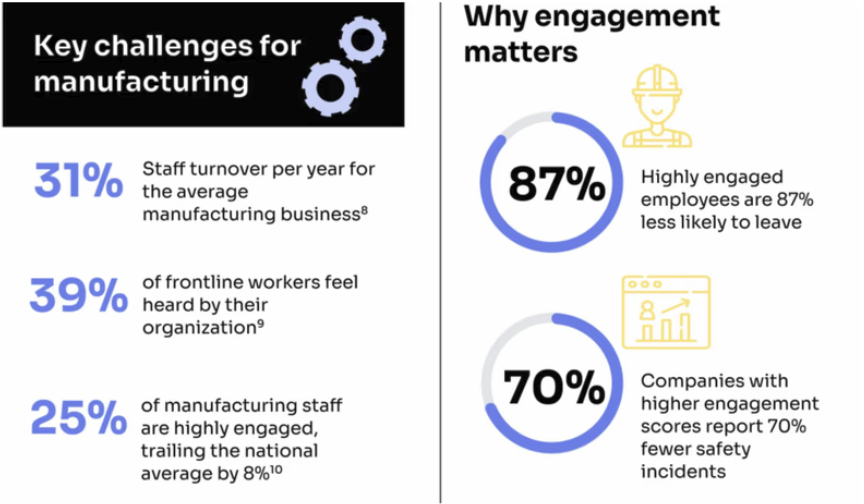
When a skilled operator walks out your door, they take more than their technical skills with them. You lose years of process knowledge, equipment expertise, and mentoring capability that can't be replaced overnight. As the fifth greatest workforce challenge in the manufacturing sector, companies know this all too well.
Keeping your best talent isn't only about fancy perks or huge paychecks. Create an environment where skilled workers see real value in their work and invest in their development.
- Offer clear career pathways and opportunities for advancement: Show skill-based progression paths for both technical experts and management tracks. Publicise these paths on your website so potential candidates understand the opportunities.
- Employee recognition and reward programs: Reward contributions to quality, safety, and operational excellence. Offer bonuses, gift cards, or extra time off, and let employees choose.
- Cultivate a positive company culture and work-life balance: Offer flexible shifts, comfortable break areas, and tools for the job. Promote team spirit without disrupting operations.
- Role of leadership in fostering engagement: Get management on the production floor, ask for input, clear obstacles, and show how daily work drives success.
- Encourage transparency and open communication: Hold meaningful shift meetings, share performance metrics, and reward employee suggestions.